What a Rebrand Actually Costs (and What It Pays Back)
Ask five agencies what a rebrand costs and you will get five confident answers that have almost nothing in common. Here is where the money really goes, and what it pays back.
Sama Sandy
September 14, 2026 · 11 min read

Ask five agencies what a rebrand costs and you will get five confident answers that have almost nothing in common. That is not because anyone is lying to you. It is because "rebrand" describes everything from a logo refresh to a company-wide overhaul of how you talk about yourself in every market you operate in. Before you can budget for one, you need to know which project you are actually buying.
Here is the honest breakdown we walk clients through, including the line item that blows up more rebrand budgets than any other.
The Three Buckets Every Rebrand Budget Falls Into
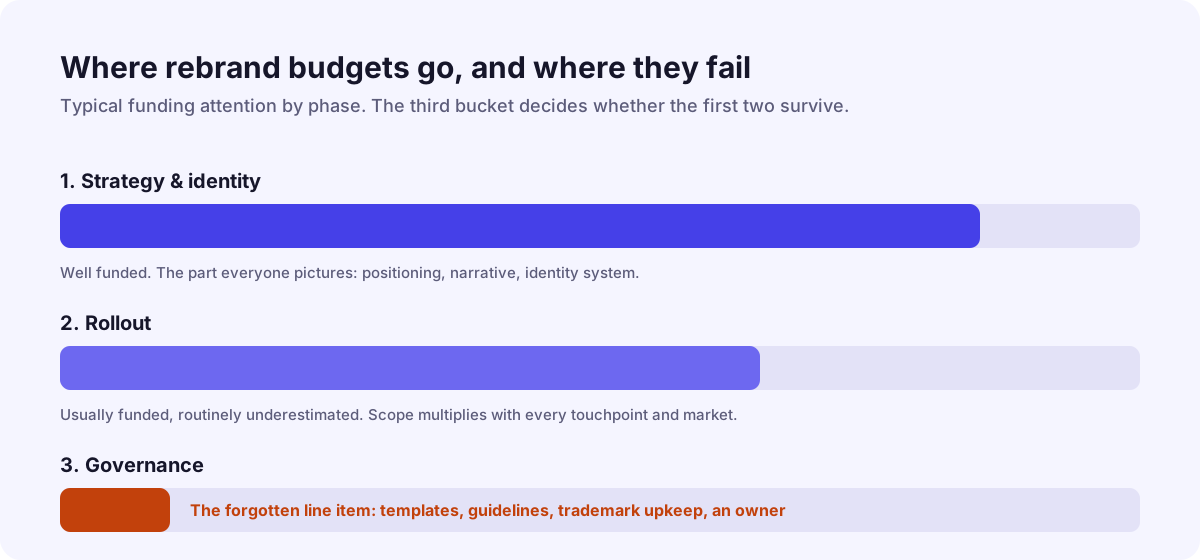
1. Strategy and identity. This is the part everyone pictures: positioning work, the corporate narrative, naming if you need it, the visual identity system, the tagline. That is the identity layer, which is not the same thing as the brand itself; brand identity versus branding covers that distinction. It is also the part where skimping hurts most, because everything downstream inherits its quality. A rebrand built on a weak strategic foundation is an expensive coat of paint.
2. Rollout. The new brand has to actually reach the world: your website, sales materials, product packaging, signage, tradeshow properties, email templates, social profiles, vehicle wraps if you have them. For a company with one website and a couple of brochures, rollout is a quick project measured in weeks. For a company selling through distributor networks in a dozen countries with a sixty-event annual calendar, rollout is a program measured in quarters. Same word, completely different budget.
3. Governance. This is the hidden line item. Someone has to make the new system hold: templates people can actually use, guidelines that answer real questions, a review process that keeps regional teams and vendors on-brand without becoming a bottleneck. Most rebrand budgets allocate nothing here, which is why so many companies are visibly off-brand again within eighteen months. The brand did not fail. The governance was never funded.
Each bucket deserves a closer look, because each one hides a cost that only shows up after the contract is signed.
Strategy Is Choices, Not Adjectives
The first distinction any MBA strategy classroom hammers home is deceptively simple: corporate strategy answers where to play, and business strategy answers how to win. I am partway through mine, and it is striking how directly that maps to brand work, because most weak rebrands skip both questions and jump straight to adjectives. Modern. Bold. Trusted. Adjectives are not a strategy.
A strategy phase that earns its budget forces three real answers before anyone opens a design tool:
- →Where to play. Which markets, segments, and buyers is this brand for, and, just as important, which ones is it deliberately not for? A brand that tries to speak to everyone ends up competing against everyone.
- →How to win. Michael Porter's classic framing says you win through lower cost, meaningful differentiation, or sharp focus on a niche, and the dangerous place is the mushy middle. Your brand narrative has to commit to the same choice your business model makes. A premium story wrapped around a cost-driven operation reads as fake within one buying cycle, and buyers rarely tell you why they left.
- →The better-off test. Porter's tests for diversification include a question worth stealing for brand architecture: is each product line better off carrying the master brand, and is the master brand better off carrying it? If the honest answer is no, you do not need a bigger brand. You need a second brand, or a shorter product list.
The identity system is the last step of strategy, not the first step of design. When the positioning survives those three questions, the tagline nearly writes itself, and everything downstream stops being a matter of taste.
Rollout Is a Change Program, Not a Distribution List
The classic rollout mistake is treating it as asset distribution: swap the logos, ship the templates, done. Strategy courses spend entire weeks on why smart strategies die in execution, and the culprit is almost always alignment: the organization's daily behavior does not match the story it has been handed. Rebrands die the same death.
Two lessons transfer straight from the strategy classroom to the rollout plan:
- →Employees are the first market. A rebrand launches internally before it launches externally. If sales, support, and the shop floor cannot say what changed and why in one sentence, the outside world is getting a reskin, not a rebrand. This is culture and strategy alignment in miniature: the story holds when leaders model it daily, in pipeline reviews and customer calls, not just at the launch party.
- →Codify what should scale, personalize what needs judgment. Knowledge-management research (Hansen, Nohria, and Tierney's codification versus personalization distinction) gives rollout its operating model. Codify the repeatable: templates, usage rules, asset libraries anyone can pull from without asking. Personalize the judgment calls: name brand champions in each region or business unit who learn the system by working alongside the core team, then carry it person to person. Companies that codify everything get compliance without conviction. Companies that personalize everything get conviction that never scales.
Sequence matters too. Pilot the rollout in one market or business unit, harvest what breaks, then wave the rest. A stumble in the pilot costs a sprint; the same stumble launched globally costs a quarter.
Governance Includes the Legal Side of Your Name
Here is a governance cost almost nobody puts in the initial estimate: what your names are legally allowed to be in each market you sell in.
A product name that works beautifully in your home market can be blocked by an existing trademark in another country, or fall apart in translation. I have watched this play out repeatedly in global industrial marketing: a product line earns its name in North America, then expansion plans meet an international trademark registry and the name simply is not available there. At that point the brand has real choices to make, and none of them are free:
- →Rename the product for that region and maintain a naming map so sales, support, and documentation stay coherent.
- →Redesign the regional product mark so the visual system holds even where the name changes.
- →File for region-specific trademark registrations early enough that the name you love is still available when you need it.
Which path is right depends on the market, the mark, and the filing landscape, and it is a decision to make with your trademark counsel, not your design agency. The budgeting lesson is simpler: if your rebrand touches product naming and you operate internationally, put trademark searches, filings, and the occasional forced rename into the governance bucket on day one. Discovering them mid-rollout is how timelines slip by quarters.
What Actually Drives the Price
Scope is the obvious driver, but three multipliers matter more than most companies expect:
- →Touchpoint count. Every place your brand appears is a line item in rollout. When I was at SPIRE Credit Union (now Blaze), we transitioned from "SPIRE Federal Credit Union" to "SPIRE Credit Union." One word removed. I called it trying to clean up sand: that single word lived in every branded piece and every legal document the organization had. Hundreds of letterheads, disclosures, and legal templates each needed their own find-and-replace pass, review, and reprint. Count your touchpoints honestly before you start, including the legal paperwork nobody thinks of as "brand," and you will avoid the mid-project budget surprise that catches most teams.
- →Internal alignment. If leadership has not agreed on what the company is becoming, you will pay your agency to referee that debate. Strategy phases stretch when the real product is consensus.
- →Markets and languages. Global consistency is a different project than domestic consistency. Localization, regional review cycles, market-specific assets, and the trademark work above all scale the cost.
What It Pays Back
A rebrand is not a growth engine on its own, and any agency that promises "rebrand equals more leads" is selling you the coat of paint. What a rebrand buys is a foundation that makes everything built on top of it work harder.
Here is what that looked like at a global industrial-technology manufacturer where I lead brand and creative. The rebrand itself was deliberately scoped: a more public-facing tagline and an evolved mascot mark, while the core logo stayed. No drama, no yearlong identity odyssey. The growth came from what we layered on top of that foundation: a stronger presence in trade publications, contributed white papers, and a library of genuinely useful content, from technician tech-tip videos to animated explainers, that the sales team could put in front of customers, which is how industrial buyers actually choose suppliers. Qualified leads grew ten percent year over year from that combined push.
The rebrand's job in that story was coherence: making sure every article, video, booth, and sales conversation looked and sounded like one company. That is the honest payback math:
- →Speed. Settled narrative, templates, and rules mean every launch and campaign starts from a running start instead of a blank page.
- →Trust. Buyers notice coherence even when they never articulate it, and coherence is most of what a brand customers trust is built on. When the website, the sales deck, and the tradeshow booth tell the same story, the story becomes believable.
- →Leverage. Every marketing dollar you spend after the rebrand, on content, events, or media, lands with more force because it reinforces one identity instead of many.
Green Flags and Red Flags
Signs a rebrand will earn its budget (if you are still deciding whether to rebrand at all, start with Rebranding 101):
- →✓ The business has outgrown the story: what you sell, who buys it, or how big you are no longer matches the brand.
- →✓ Leadership can name the business outcome the rebrand should support, before seeing a single design.
- →✓ Rollout and governance have their own budget lines, not leftovers.
- →✓ Product naming and trademarks are being reviewed with counsel in every market that matters.
- →✓ Someone owns the brand after launch day, with real authority.
Signs you are about to buy an expensive coat of paint:
- →✗ Leads are dropping because of a product or pricing problem. New paint does not fix that.
- →✗ "We just want a refresh" with no business outcome attached.
- →✗ A merger, acquisition, or major pivot is six months away and will reopen every question anyway.
- →✗ The plan funds a beautiful guidelines PDF and nothing that helps people follow it.
- →✗ The timeline assumes the old name lives in twelve places when it actually lives in twelve hundred.
How to Budget It Without Getting Burned
- →Phase it. Fund strategy and identity first, as its own project with its own deliverables. You will make far better rollout decisions once the system exists.
- →Count touchpoints before you sign anything. Include legal documents, contracts, and disclosures, not just the marketing surfaces. An afternoon with a spreadsheet beats a change order every time.
- →Put trademark work in the plan. Searches and filings for every market on the roadmap, with counsel, before you fall in love with a name.
- →Fund governance explicitly. Even a modest allocation for templates, guidelines, and a rollout owner protects everything else you spent.
- →Tie it to one business metric. Pipeline quality, sales cycle length, launch velocity. Pick one before you start so "did it work?" has an answer, then put it on your one-page marketing scorecard so it gets looked at every month.
The Bottom Line
A rebrand is infrastructure. Done well, it does not just change how a company looks; it changes the return on every piece of marketing that comes after it, because every campaign, launch, and conversation compounds on one coherent identity instead of fragmenting across many. The companies that get burned are the ones that buy the visible third of the project and skip the two thirds that make it hold. Budget all three buckets, put your names on solid legal ground in every market you plan to win, and give the system an owner. Then the question stops being "what did the rebrand cost?" and becomes "how did we ever run launches without it?"
Thinking about whether your brand still fits the business it represents? See how we approach brand strategy or start a conversation.
Sources
- →Michael E. Porter, Competitive Strategy: Techniques for Analyzing Industries and Competitors (Free Press, 1980)
- →Michael E. Porter: What Is Strategy? (Harvard Business Review) (November-December 1996)
- →Morten T. Hansen, Nitin Nohria, and Thomas Tierney: What's Your Strategy for Managing Knowledge? (Harvard Business Review) (March-April 1999)
- →Case-study figures are Yayah Creative Co's own client work, shared with permission.
Ready to Grow?
Stop reading about strategy. Let's build yours.
One real conversation is worth more than any article. Tell us what you're trying to grow — we'll tell you exactly how we'd approach it. No pitch. No commitment.
Yayah Creative Co
Marketing · Creative · Strategy · AI Systems
15+ years of hands-on marketing work across corporate, agency, and entrepreneurial environments. We don't just write about strategy — we execute it every day.
Work With Us →Keep Reading
Related Articles

AI & Technology
AI in Collections, Getting Started, Part 2: An Intake and Triage Workflow Your Compliance Team Can Review

AI & Technology
Build Your First AI Agent, Part 1: What an Agent Actually Is (No Code, No Hype)

Digital Marketing